M.C. Escher

The Metamorphoses of Atrani

The perspective that became vision

Discover

The vertical village

In May 1931, after recognising in Atrani a wholly new geometry, M.C. Escher returned to follow that vision. He climbed almost five hundred steps, through impossible stairways, arches and lanes — the same ones that inspired Incrocio ad Atrani — all the way up to the House of Masaniello. From there he opened his eyes onto the perspective he was seeking: infinity with the bell tower of Santa Maria Maddalena, which the artist described as “a bridge of an urban ship over the Mediterranean.” The same perspective that can still be enjoyed today from this house, where history and art merge into a single gaze.

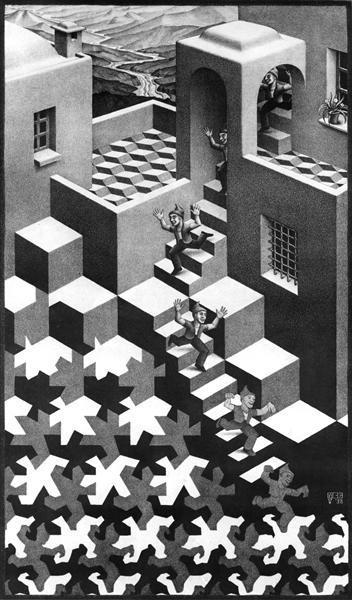
Impossible stairways by M.C. Escher
M.C. Escher, Impossible Stairways
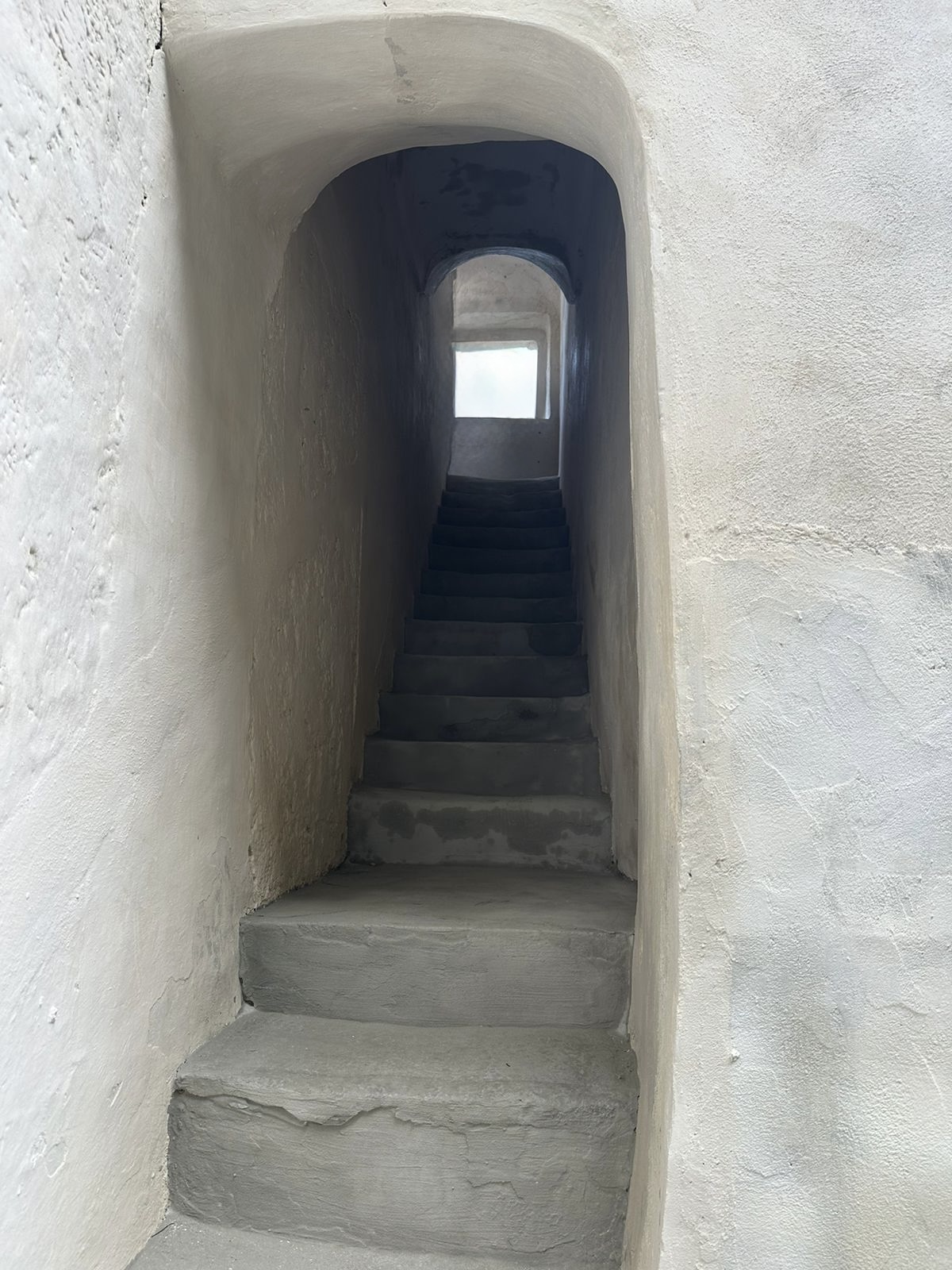
Outdoor staircase of the House of Masaniello
Outdoor staircase, the House of Masaniello

The staircases: an invitation to climb into the vision

The staircases of Atrani are the first sign of this experience. They climb between houses, arches and narrow passages, turning every movement into a shifting perception of space. In Escher this movement already becomes a mental language: no longer a simple ascent, but a structure of thought.

The same energy can still be felt climbing towards the House of Masaniello, with the charm of the covered external staircase overlooking the sea.

Metamorphosis: Atrani becomes a chessboard

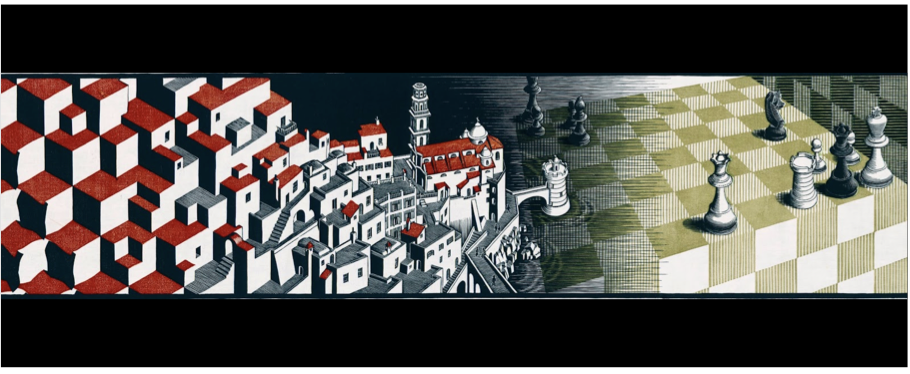
In Metamorphosis II, Atrani turns into an endless chessboard: houses become pawns, Norman towers become pieces in a cosmic game. Escher started right here — from these almost 500 steps rising from sea to sky — to create one of the most celebrated works of the twentieth century, where the village is no longer just a real place but a principle of continuous transformation.

Metamorphosis II by M.C. Escher

M.C. Escher, Metamorphosis II (detail), 1939-1940 — Woodcut

Metamorphosis I by M.C. Escher

M.C. Escher, Metamorphosis I, 1937 — Woodcut

Incrocio ad Atrani evokes perfectly the vertical labyrinth you climbed on the way up to the House of Masaniello. Arch upon arch, stairways intertwining, perspectives that defy logic. Escher captured the essence of this place: a space that deceives, a perspective that bends reality.

Incrocio ad Atrani by M.C. Escher

M.C. Escher, Incrocio ad Atrani, 1931 — Woodcut

The evolving gaze: from the Grand Tour to photography

Before Escher, the Grand Tour had already fixed Atrani as a vertical theatre. Ferdinand Witting, in 1844, captured the ascent and the intertwining of its architecture in a view that is among the most evocative of the whole nineteenth-century tradition.

Ferdinand Witting, Atrani, 1844

Ferdinand Witting, 1844 — The ascent to the House of Masaniello

Shortly after, Italian painters also returned to the same landscape. Giovanni Giordano Lanza, Antonio Ferrigno and above all Giacinto Gigante recognised in Atrani a natural composition of rock, houses and sky, in which one can still read, high above, the presence of the House of Masaniello.

Painting by Giacinto Gigante with the House of Masaniello in the background

Giacinto Gigante, mid-nineteenth century — Atrani with the House of Masaniello recognisable above

The house indicated: Gregorovius and the charcoal sketch

Ferdinand Gregorovius, a German historian in love with Italy, walked these same steps in 1856. In his travel journal he accompanied the words with a charcoal sketch, marking the House of Masaniello, recognisable on the heights and almost dominating the village. It was the moment of greatest bloom for a centuries-old cult: in the romantic and Risorgimento nineteenth century, the myth of the rebel fisherman who had led Naples against Spanish misrule in July 1647 had spread throughout Europe, and his house had become a mandatory stop — a destination for Grand Tour painters, historians and photographers.

Gregorovius sketch indicating the House of Masaniello

Ferdinand Gregorovius, 1856 — Charcoal panorama of Atrani with the mark on the House of Masaniello

With the Alinari Brothers, at the end of the nineteenth century, this story moves from painting and drawing to photography. Their lens captures the same light that bathes your steps today — the dazzling white of the houses, the deep blue of the Tyrrhenian Sea, the gold of ripe lemons — with the House of Masaniello as the protagonist of the lens and the caption: one of the shots that mark the dawn of Italian photography.

Atrani photographed by the Alinari Brothers in the 1890s

Alinari Brothers, 1890 — ATRANI (Surroundings of Amalfi). Panorama with the House of Masaniello

“To stay here is to inhabit a perspective that has enchanted the world.”

The evolving gaze

From brush to camera

From Romantic painters to pioneering photographers, from graphic artists to contemporary directors: Atrani and the House of Masaniello have inspired two centuries of gazes.

The Equalizer 3

Denzel Washington, recovering from his injury, is stunned before the commanding view of the Sanctuary and the House of Masaniello. The landscape that stops him is the same one that stopped Escher ninety years earlier.

Ripley

The staircases turn into endless labyrinths in the signature black-and-white of the Netflix series. The same impossible geometry that obsessed Escher becomes a setting for crime and desire.

Cinema & Landscape

The Equalizer 3

Denzel Washington contemplating the House of Masaniello and the Sanctuary

Ripley

Netflix Series — 2024

Ripley

Andrew Scott — Atrani, step by step